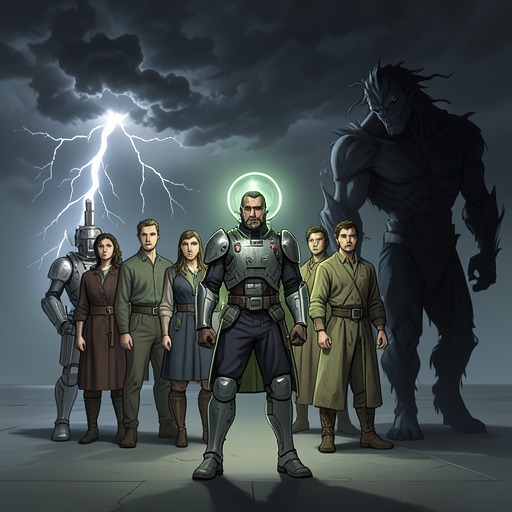
Isaac Hartson
Systema Delenda EstIsaac Hartson is a registered D-class metahuman whose small-scale life conceals an unusually deliberate campaign against the superheroes and supervillains who dominate Star City. He regards both sides as violent powers operating without consequences, and his objective is not to become one of them but to make them answer for what they do. Because he lacks the strength, ruthlessness, and institutional protection required to confront major supers directly, his resistance takes the form of preparation, disguise, intelligence gathering, and carefully limited criminal action.
Identity and Circumstances
Isaac’s distrust of supers is rooted in more than abstract resentment. Growing up in the foster care system taught him that people in authority were usually pursuing their own interests, while even foster housing proved to be a calculated public-relations exercise rather than uncomplicated care. His experience has made him suspicious of every institution that claims to protect the vulnerable. Superheroes appear to him as nominal police who are nevertheless violent, dangerous, and impressed by their own power; supervillains are more openly predatory, but neither group is meaningfully accountable to ordinary people.
His social position reinforces that judgment. Isaac works at Saint Anne’s Metahuman Hospital, where he is little more than a glorified janitor tasked with moving exceptionally heavy medical equipment. He is permitted to handle megacredit scanners, bracers, regenerators, and similar machines because his power gives him extraordinary finesse, not because his employers value him. Mister Graham, an A-class nuisance with C-class psychometry approaching technopathy, takes credit for the maintenance department while avoiding blame, contributing to Isaac’s nearly nonexistent raises. Isaac accepts the invisibility of janitorial work because it gives him access to the hospital and information about supers, while registration as even a D-grade meta closes ordinary employment opportunities.
Power, Cover, and Method
Isaac’s apparent strength is a misclassification. His actual ability concerns inertia, the resistance of an object to changes in motion. He can reduce the inertia of something enormous to almost nothing, allowing him to push heavy machinery around corners without effort and move it without damaging walls or people. He cannot cancel gravity or simply lift large objects, which explains his modest official rating, but his power becomes more versatile when applied with planning.
The ability also permits a controlled contrast between an object’s original inertia and its altered state. Isaac can brace himself against a scanner shell as though it still weighed five tons, while moving his painted foam armor as though it were ordinary foam rather than an object burdened with the inertia he has invested in it. Temporary borrowing and redistribution of inertia is possible but troublesome, so he rarely relies on it. His practical advantage lies in turning seemingly harmless materials, clothing, and props into tools while preserving a mundane appearance.
Anonymity is as important to Isaac as the power itself. He has spent years making costumes, but he avoids imitating recognizable superheroes because Star Central protects its images and copying supervillains is even more dangerous. For the robbery, he creates the persona of Dimetria, using painted and printed foam armor and a radioactive blonde wig. Afterward, he removes the costume, destroys the disguise in a burn barrel, washes away heavy makeup with wet wipes, and emerges from a parking-garage stairwell looking like an ordinary homeless man. He even dismantles the borrowed shopping cart by removing screws rather than leaving it in the street.
The Softchip Heist and Its Purpose
Isaac’s first major operation is a robbery of an armored car carrying racks of softchips in padded cases. The vehicle has no metahuman security because the chips are not valuable enough to attract a serious villain, a weakness Isaac exploits rather than overcomes through combat. A guard’s bullets strike his pink armor and fall harmlessly to the ground, after which Dimetria takes two cases and escapes through the buildings, railways, and roads with only a few scattered gunshots following her.
The robbery is not motivated by greed. Isaac intends to use the proceeds or equipment to empower Cayleb Ruston, his roommate and closest ally, effectively treating him as a brother even though the relationship is not formally familial. Isaac’s plan depends on Cayleb’s tinker talent: armor and weapons are obvious possibilities, but transportation, communications, and fabrication may be more valuable for a low-level operative who cannot afford exposure. Isaac has spent months planning the heist, testing his ability in secret, and deciding how to present the stolen material. Crossing from planning into action gives him a surge of satisfaction, because the robbery seems to be the first concrete step toward building a force capable of challenging powerful supers.
The result immediately undercuts that hope. The stolen softchips turn out to be useless for the intended purpose, rendering Isaac’s first great crime practically pointless. He tells himself that the failure does not matter and that he will solve it the next day, but the dismissal cannot erase the structural problem: individual courage and cleverness are insufficient without technical support. He liquidates the remaining chips through Kleppy’s pawn shop, returning three times over two weeks and using his ganger persona each time. The disguise lets him walk fearlessly through dangerous streets, although he knows that being exposed as someone merely pretending to belong to Crash Hardiron’s gang could be fatal.
Gangs, Intelligence, and Escalation
Isaac refuses to imagine himself killing Blacktime or Glorybeam. He knows that he is not powerful enough to confront figures at that level, and he does not actually want to become a supervillain: successful villains are powerful, ruthless, and terrifying, while less successful ones are quickly crushed by heroes, rival villains, or the larger organizations that employ them. Instead, he identifies Crash Hardiron, a local gang leader and apparently an old friend of Blacktime, as a more realistic target. Isaac believes Crash possesses dirt, connections, and information that could be sold to rival gangs or the media. Bringing down a major power does not necessarily require killing that power; damaging its network may be enough.
To obtain such access, Isaac contacts Kevin, a former friend whose metal blade forearms have made him nearly unemployable and pushed him into a supervillain gang. Isaac understands why Kevin accepted the gang’s protection and income, but he does not romanticize the choice. At a run-down gas station, he approaches in the posture of an arrogant superior ganger, stepping into Kevin’s personal space and suppressing his own empathy. Kevin is compact and wiry, with steel-colored arms, dirty blond hair, a long face, and the glazed twitchiness of drug addiction. Isaac has prepared for the possibility that Kevin may attack, using his power to make himself resistant to bullets and blades, and he treats the meeting as a negotiation with a dangerous criminal rather than a reunion.
After the encounter, Isaac abandons the ganger identity in an alley. He removes the jacket and chains from his clothing, wipes away the tattoo with alcohol, ruffles his hair, and resumes the slight hunch of his janitor persona. This repeated movement between identities is not theatrical self-expression so much as operational survival. Isaac’s personas allow him to pass through different social worlds while keeping each world from seeing the others. His caution is grounded in hospital experience and research: he considers supers, whether heroic or villainous, brutal mercenaries who can cause destruction and death without hesitation.
Cayleb, Star Central, and the Decision to Disappear
The campaign changes when Cayleb is recruited by superheroes. Isaac repeatedly checks his network accounts and finds no message, entering a constricted routine of work and home that makes his sleep restless and his job increasingly irritating. He has few friends outside Cayleb, so the uncertainty is both emotional and practical: without his former roommate, Isaac loses the person whose tinker work might make his campaign possible, as well as the relationship that gives the campaign its immediate human center.
At last, three weeks after the recruitment, Cayleb sends a message headed "whoops!" Isaac’s unease deepens rather than lifting. He goes to Star Central, a climate-controlled and spotless facility crowded with more metas than he has previously seen together. Many gather near the Tasks and Bounties desk, while others enter a personnel-only area. Isaac approaches the information desk and asks about Cayleb Ruston, performing uncertainty even though he has rehearsed the conversation repeatedly. The receptionist searches the records and reports that Cayleb is on a classified project.
The answer is delivered by Glorybeam, who appears behind Isaac in black-and-gold armor marked with Star Central’s insignia. She identifies him as Isaac Hartson, a worker at Saint Anne’s Metahuman Hospital, making clear that Star Central already knows who he is. Glorybeam orders him to return Monday at noon. Isaac immediately begins looking for a way out. Cayleb may be safe, or he may be trapped inside something terrible; either possibility threatens Isaac’s objective, because Star Central’s control would mean less freedom and no greater accountability for supers or for Cayleb himself. The encounter therefore turns a secret campaign into an urgent personal crisis. Isaac’s final decision is direct and severe: he needs to disappear.